
Why Lean Manufacturing in Precast Concrete Is Harder to Sustain Than to Start
Most precast plants I’ve visited have at least one piece of software that nobody uses anymore. It might be a scheduling tool that got replaced by a whiteboard, a quality system that lives in one person’s laptop, or a BIM model that the production team has never opened. Lean manufacturing in precast concrete faces the same problem: the ideas get introduced, something improves for a while, and then production pressure takes over and things drift back to where they started.
The technology wasn’t necessarily bad. The process wasn’t necessarily wrong. The problem was that neither arrived with the connected foundation needed to sustain it.
After 21 years working inside precast manufacturing, I’ve come to think of this as the core challenge in the industry: plants keep adding tools to a process that isn’t connected end-to-end. Until that changes, both lean and technology investments will continue to underperform.
The Same Element, Made Differently Every Shift
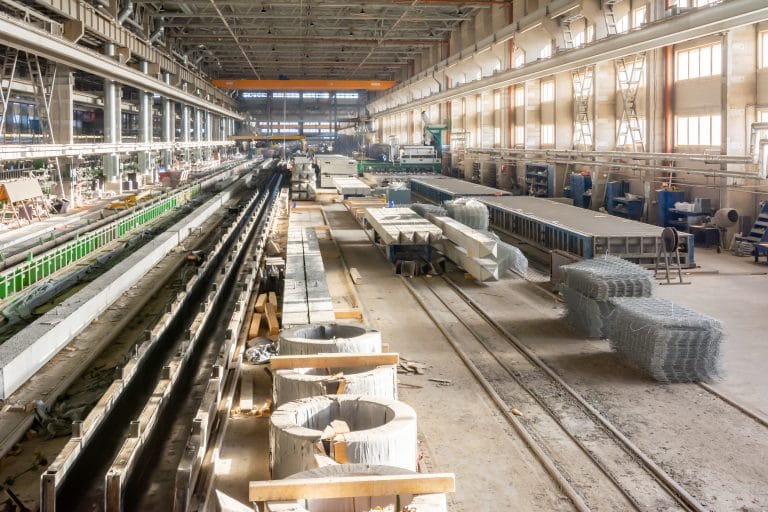
Walk the production floor of most precast facilities, and you’ll notice something: the same element gets produced differently depending on who’s working. Reinforcement placement varies. Formwork setup follows different sequences. Concrete placement depends on individual habit rather than a documented method.
This isn’t a people problem. It’s a systems problem. When there’s no defined standard for how critical work gets done, variation is the inevitable result. And variation in production leads directly to variation in quality, cycle time, and cost.
This isn’t a people problem. It’s a systems problem. When there’s no defined standard for how critical work gets done, variation is the inevitable result. And variation in production leads directly to variation in quality, cycle time, and cost.
Quality Control Happens Too Late
The way most precast plants manage quality is fundamentally reactive. You make the element, then you inspect it. You check dimensions, look for surface defects, and test the strength of concrete from cured samples.
These checks are necessary, but they tell you what went wrong after the fact. By the time you find a problem, the element is already made. In the worst cases, it’s already on site.
The process conditions that actually determine quality – concrete temperature during curing, reinforcement position during cage assembly, formwork alignment before the pour – receive far less systematic attention. The sensors and monitoring equipment to track these things exist and are not prohibitively expensive. The gap is not in the availability of technology. It’s that plants haven’t built quality monitoring into the process itself.
The same gap exists in the feedback loop from the site back to the factory. When a connection doesn’t fit, when an element arrives damaged, when tolerances are out – that information needs to travel back to design and production in a structured way. In most cases, it doesn’t. The knowledge stays with the site crew, and the same issue appears on the next project.
Data That Can’t Talk to Itself
Here’s a description of a fairly typical precast operation. The BIM model holds the geometry. The ERP system holds the schedule. Production planning happens in Excel. Machine controllers run their own software. The site team works from paper drawings with handwritten annotations.
Each of these systems contains useful information. None of them talks to each other reliably. Nobody can tell you in real time which elements are ready, which are curing, and which haven’t started yet. Production decisions get made based on someone’s memory and what’s written on the whiteboard.
Manufacturing Execution Systems were designed specifically to solve this problem. An MES sits between your design and planning systems on one side and your production floor on the other. It tracks each element throughout the process, integrates with your equipment, and automatically captures quality data. Precast plants that implement MES properly get visibility they didn’t have before. But MES implementation only works when the underlying process is stable enough to be worth tracking.
Why Lean Manufacturing and Digital Tools Need Each Other in Precast Concrete
The two most common failure modes I see are:
- Automation without process discipline. A plant invests in new equipment or software before fixing the way work flows through the facility. The technology is then forced to accommodate a broken process, and the promised gains never materialise.
- Lean improvements without digital infrastructure. A plant maps its value stream, eliminates obvious waste, and achieves real improvements. Then, over six months, production pressure erodes the gains because there’s no system in place to maintain the new standard.
The combination works. Map your process, eliminate the waste that’s clearly visible, document the improved standard, then implement digital tools that help people maintain it. That sequence matters. Skipping steps in either direction costs money.
Where to Start
If I were advising a precast plant starting this work today, I’d suggest focusing on four areas:
- Standard work for critical operations. Not lengthy written procedures that nobody reads. Visual instructions at the point of work, specific enough to be useful, simple enough to be followed.
- A manufacturing execution system that fits your operation. It should track each element from design through production to installation, connect with your existing equipment where possible, and capture quality data without requiring manual data entry.
- Basic process monitoring at the points that matter most. Maturity sensors for curing, position verification during reinforcement assembly, and environmental controls in the casting area. Quality should be something your process produces, not something you check for afterwards.
- A structured site feedback loop. Make it straightforward for site teams to report what went wrong and what that means for production. The information already exists. The goal is getting it back to the people who can act on it.
None of this requires technology that doesn’t already exist. Most of it doesn’t require a large capital investment. What it requires is treating the production process with the same seriousness that other manufacturing sectors have applied for years.
The question worth asking isn’t whether this is possible. It’s why so few precast plants have done it yet.