

Computer Vision and AI in Precast Manufacturing: What’s Actually Possible Now
Most people working in precast already know this, but don’t often say it directly: quality control on the production floor hasn’t fundamentally changed in decades. A trained eye, a tape measure, a checklist, and maybe a go/no-go gauge on the connection details. For many manufacturers, that’s still the daily reality.
Meanwhile, other manufacturing sectors have moved on. Automotive assembly lines inspect every weld, every component fit, and every surface finish at production speed without anyone lifting a gauge. Semiconductor manufacturers detect micron-level defects before a chip leaves the cleanroom. Aerospace producers verify composite layups against digital models before the material ever goes into an autoclave.
These aren’t experimental systems. They’re standard practice in sectors that have decided to treat quality as part of the production process rather than something you check at the end.
So the question worth asking isn’t whether this kind of technology can work in a precast factory. The question is what’s actually possible when you combine computer vision with AI systems that don’t just detect problems but act on them.
What Computer Vision Actually Does on a Precast Production Floor
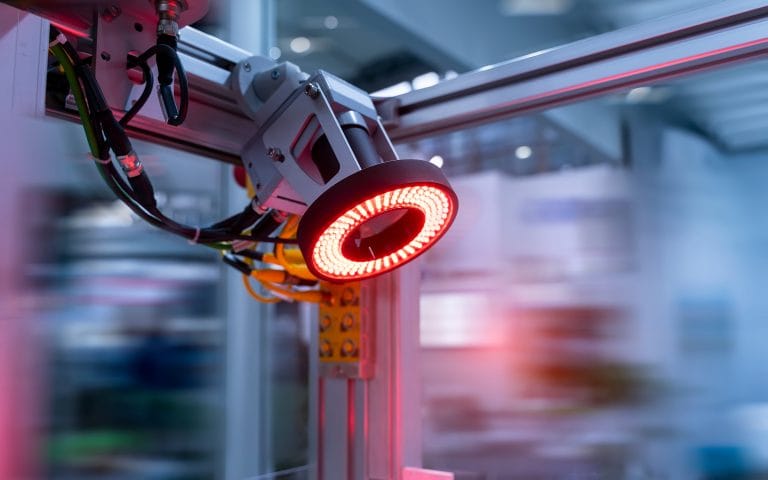
Computer vision systems use cameras, 3D scanners, and image processing to continuously analyse what’s happening on the production floor, at speed, and without fatigue.
Computer vision systems use cameras, 3D scanners, and image processing to continuously analyse what’s happening on the production floor, at speed, and without fatigue.
In a precast context, this means:
The same principle applies on the installation side. Cameras and 3D scanning can track column plumb, monitor tolerance accumulation during erection sequences, and confirm that connections have been made as specified.
Research published in Automation in Construction (Alsakka et al., 2023) reviewed computer vision applications in off-site construction and found consistent evidence that automated inspection systems reduce defect escape rates and identify quality issues earlier in the production cycle, when they’re still relatively cheap to fix. Separate research on deep learning for concrete defect detection confirmed that convolutional neural networks can match or exceed human inspection accuracy for surface defect identification (Arafin, Billah & Issa, 2024, Structural Health Monitoring).
The more important point isn’t the technology itself. It’s where it sits in the process. Inspection before dispatch turns what would have become an on-site problem into a production correction. Dimensional mismatches, connection fit failures, and surface repairs on site cost substantially more to resolve than the same issues caught during production. That’s not a new insight, but it is one that the industry has had limited tools to act on consistently.
Agentic AI: The Difference Between Detecting a Problem and Doing Something About It
Standard AI systems detect problems. That’s genuinely useful, but it’s still reactive. Someone has to read the alert, decide what to do, and act on it. In a busy production environment, that gap between detection and response is another point where things go wrong.
Agentic AI works differently. Deloitte defines it as AI systems that can act autonomously to achieve specific goals, not just flagging issues but taking defined actions across connected systems without waiting for human instruction at each step (Deloitte Insights, 2025).
In a manufacturing context, Deloitte draws a clear distinction between a standard quality inspection agent, which scans components and flags defects, and an agentic system, which can independently re-sequence production when a problem is detected, update the digital twin with as-built data, notify downstream teams, and flag structural sensitivity implications if a connection defect exceeds a defined threshold.
McKinsey’s research on agentic AI in advanced industries found that manufacturers report improved defect-detection rates through automated visual anomaly detection, and that logistics operations have achieved reductions of over 20% in inventory and logistics costs through autonomous scheduling systems (McKinsey, September 2025).
Gartner named agentic AI the top strategic technology trend for 2025. Deloitte projects that 25% of enterprises using generative AI will have autonomous AI agents deployed in 2025, rising to 50% by 2027. These aren’t figures about an emerging concept being trialled in pilot programmes. They reflect a shift already underway in how manufacturers are running their operations.
For precast specifically, the practical effect of combining computer vision with an agentic system is this: the factory stops being a collection of separately monitored processes and starts functioning as a closed loop. Defect detected. Production paused or re-routed. Issue logged. Engineering flags any structural concern. Schedule updated. Without a phone call.
Three Specific Problems This Addresses
Rather than describing what the technology can theoretically do, it’s worth being direct about the problems it solves for precast manufacturers in practice.
1. Dimensional Mismatch at Installation
Tolerance accumulation is one of the highest hidden costs in precast and modular construction. When elements are manufactured to specification but not dimensionally verified until they reach the site, errors compound throughout the structure. A 3D scan comparison against the BIM model completed before dispatch turns an installation problem into a production correction. The element either meets the specification or it doesn’t leave. That changes the economics of project delivery in a straightforward way.
2. Connection Reliability
Connections are where precast systems are most vulnerable. Embed locations, weld quality, bolt placement, and grout completeness are the details structural engineers are most concerned about, and they’re notoriously difficult to inspect manually at production speed. Vision systems can verify these consistently across all elements, not just on a sample basis. An agentic layer can flag anything that affects structural integrity, the kind of check that matters particularly when specifying against progressive collapse requirements.
3. Feedback from Site Back to the Factory
One of the persistent weaknesses in precast production is that lessons from installation problems rarely reach the factory floor in any systematic way. A digital system that tracks as-built data, site feedback, and inspection records creates an operational record that can genuinely improve future production. Not through a lessons-learned document that gets filed and forgotten, but through data that directly informs the next production run.
The Productivity Problem This Sits Inside
None of this happens in isolation from a wider industry challenge.
McKinsey’s research found that global construction productivity grew by only 1% per year over the past two decades, compared with 2.8% for the total economy and 3.6% for manufacturing. In the United States, construction sector productivity is lower today than it was in 1968. Their 2024 update found that construction productivity improved by just 10% between 2000 and 2022, while manufacturing improved by 90% over the same period (McKinsey Global Institute, 2017; McKinsey, 2024).
Precast manufacturers who already operate closer to genuine manufacturing disciplines, with repeatable processes, measured outputs, and structured improvement, already outperform the construction industry average on productivity. Integrating vision systems and agentic AI is the natural next step in that direction.
McKinsey’s analysis suggests that a manufacturing-led approach to construction could deliver productivity gains five to ten times those of traditional methods. That figure isn’t specifically about AI; it’s about the underlying shift towards factory-based, measurable production. Digital quality systems are part of that shift, not separate from it.
What Implementation Actually Requires
The technology is not the hard part. That’s worth being honest about.
Computer vision systems are now commercially available. Deep learning models for concrete defect detection are well documented in the peer-reviewed literature. Agentic AI platforms are actively deployed across manufacturing sectors. The technical barriers are real, but they are not prohibitive.
What implementation actually requires is a decision to treat quality as part of the production system rather than as an inspection process that runs alongside it. That means integrating these tools into production control, not running them as a separate quality dashboard that someone checks at the end of a shift. It means connecting inspection data to scheduling systems, engineering review workflows, and digital twins. And it means the people running the factory have operational authority over what the system does, not just visibility into what it reports.
A camera that generates alerts nobody acts on doesn’t improve quality. A system with operational authority does.
The cultural shift involved is harder than the technical one. It’s also where the real competitive difference lies. In a low-margin industry, manufacturers who systematically capture quality data, act on it in real time, and use it to improve future production will have a structural cost advantage over those still relying on manual inspection and informal feedback loops.
Where This Is Heading
The direction is clear. Autonomous quality systems. Production schedules that adapt in real time to as-built data. Digital twins that update continuously. Maintenance triggered by condition monitoring rather than by calendar intervals.
The precast manufacturers in Europe and North America moving in this direction aren’t doing so because it’s interesting technology. They’re doing it because it addresses operational problems that are already costing them: labour availability, quality consistency, rework costs, and installation predictability.
In the Irish and UK markets specifically, where skilled labour shortages are already constraining production capacity and building safety legislation increasingly requires documented evidence of compliance, the business case for this shift is becoming less discretionary over time.
The question for any precast manufacturer is not whether to integrate computer vision and AI into production. The question is whether to do it proactively, as a deliberate operational improvement, or reactively, when a competitor’s production capacity and cost structure make the decision for you.
References:
Alsakka, F., Assaf, S., El-Chami, I., & Al-Hussein, M. (2023). Computer vision applications in offsite construction. Automation in Construction, 154, 104980.
Arafin, P., Billah, A.H.M.M., & Issa, A. (2024). Deep learning-based concrete defects classification and detection using semantic segmentation. Structural Health Monitoring, 23(1), 383-409.
Deloitte Insights (2025). Deciphering agentic AI in manufacturing. Deloitte US.
Gartner (2024). Top 10 Strategic Technology Trends for 2025. Gartner Research.
McKinsey Global Institute (2017). Reinventing Construction: A Route to Higher Productivity. McKinsey & Company.
McKinsey (2024). Delivering on construction productivity is no longer optional. McKinsey & Company, August 2024.
McKinsey (2025). Empowering advanced industries with agentic AI. McKinsey & Company, September 2025.