
Why the Construction Industry Still Builds Like It’s the 1600s (And What It’s Costing Us)
I spent over two decades inside precast manufacturing. I watched smart people work incredibly hard, and I watched projects bleed margin in entirely preventable ways. The common thread, almost every time, was that we were applying manufacturing logic to a process still rooted in craft-era thinking.
This post isn’t about bashing the construction industry. It’s about asking an honest question: if we build cars, aircraft, and medical equipment inside controlled factories, why are we still assembling complex buildings outdoors, exposed to weather, relying on sequential trades, and ordering materials in bulk “just in case”?
The Scale of What We’re Leaving on the Table
The built environment accounts for roughly 39% of global carbon dioxide emissions, according to the World Green Building Council’s 2019 report. That figure covers both the energy used to run buildings and the carbon embedded in their construction. It’s a number that should give every manufacturer and developer pause.
Beyond the environmental cost, there’s the pure commercial waste. Traditional construction sites order far more material than they consume. Cut-offs pile up in skips. Components delivered in the wrong sequence get damaged waiting. These aren’t the inevitable costs of construction. They’re symptoms of a process that was never designed with waste reduction in mind.
The irony is that the industry talks constantly about efficiency while clinging to methods that systematically undermine it.
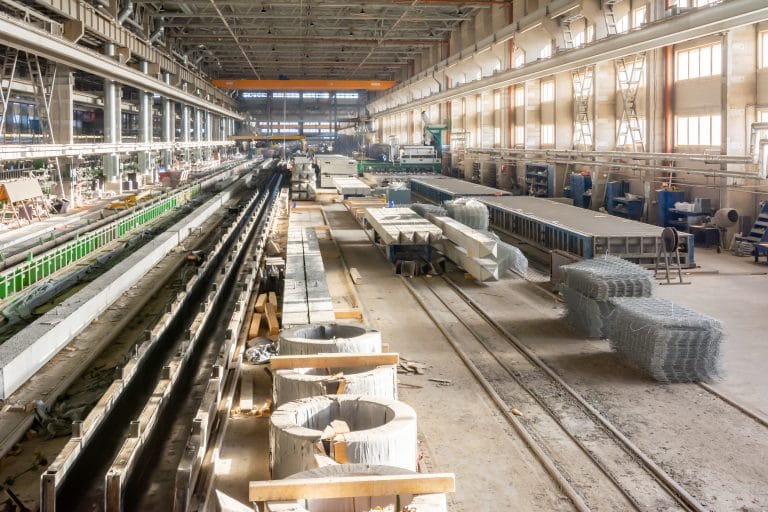
What Shifts When You Move Production Indoors
The factory environment doesn’t just protect workers from rain. It changes what’s possible at a fundamental level.
When a precast manufacturer properly designs a product for factory production, measurements are taken digitally before cutting begins. That means you’re not cutting materials to approximate dimensions and trimming on site. You’re producing components to exact tolerances, and those components fit the first time.
Worker safety improves substantially as well. A skilled operative working on a factory floor is in a controlled environment with fixed equipment, level surfaces, and consistent lighting. Compare that to the same person working 15 metres up in a winter wind. The risk profiles are not remotely comparable, and the cognitive overhead of working in dangerous conditions affects both quality and safety statistics.
The other shift is a shift in mindset. A factory is a place where you iterate and improve. You spot a recurring problem, you redesign the jig, you retrain the team, and next week the problem is gone. On a traditional building site, by the time a recurring problem becomes visible, half the building is already up.
The Parallel Processing Advantage
One of the least-discussed advantages of factory-based construction is the ability to run multiple workstreams simultaneously.
On a traditional site, one trade typically must finish before the next can start. Concrete cures, then the frame goes up, then services are roughed in, then the fit-out begins. Each stage waits for the previous one. The critical path is long because it has to be.
In a well-run precast or modular production system, the site foundations are being laid while the building components are manufactured elsewhere. Bathroom pods are being fitted out in a factory while the structural frame is being prepared on site. By the time the first delivery arrives, a significant portion of the building is already complete. It just hasn’t been assembled yet.
For a developer, this compression of the programme has real commercial value. A building that opens months earlier than a traditional equivalent isn’t just convenient. It starts generating revenue or housing tenants that much sooner.
The Counterintuitive Strength Argument
There’s a persistent assumption in the industry that factory-built means lighter, flimsier, and somehow less substantial than traditional construction. In reality, the structural requirements often run the other way.
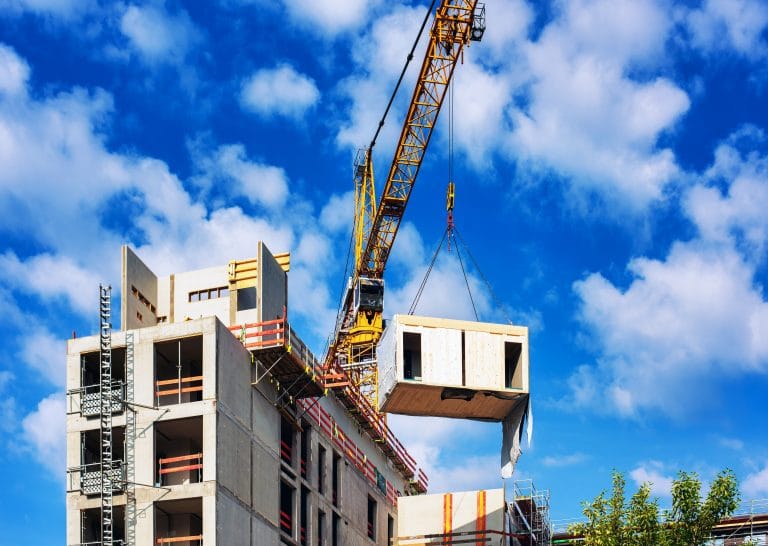
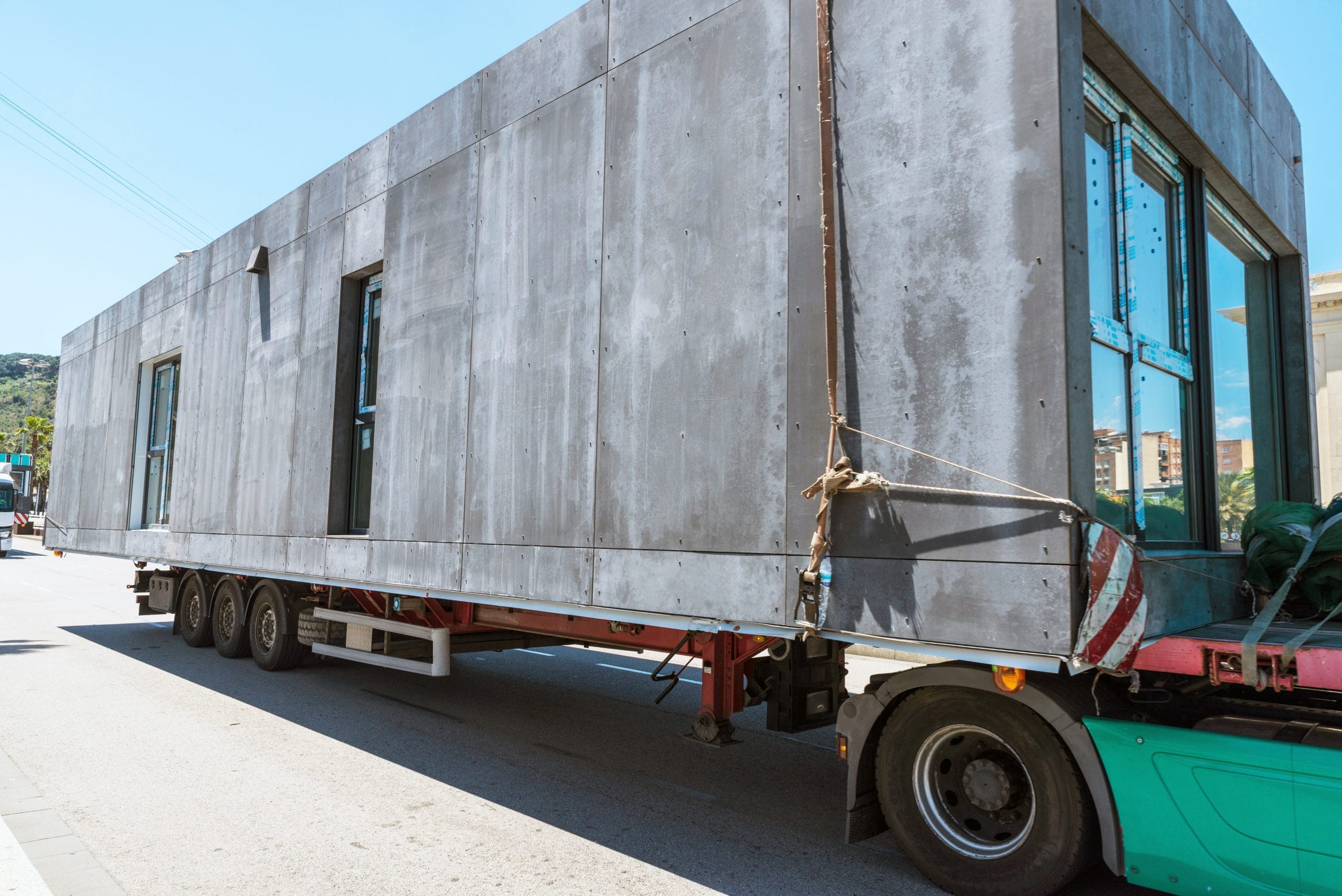
A precast or modular component that will be transported along a motorway and then lifted by crane to the upper floors of a building has to withstand loads that a traditionally built structure never experiences. Transport imposes dynamic forces. Crane lifts impose point loads at connection points. These demands push manufacturers toward higher-grade steel, more robust connections, and tighter engineering tolerances than site-built equivalents typically require.
One less-obvious result of this is acoustic performance. Where modular units meet, the double-leaf construction resulting from the manufacturing process often performs better at sound separation than a single site-built partition wall. This is particularly relevant for hotels, student accommodation, and care homes, where acoustic privacy is a genuine quality concern.
The Capacity Problem That Nobody Wants to Name
Here’s where things get uncomfortable.
The UK faces a well-documented housing shortage running into millions of homes. The modular and off-site construction sector, despite years of optimistic coverage, produces a fraction of the output needed to make a dent in that figure. The technology works. The business case is sound. The environmental case is compelling. But the capacity to deliver at the scale the problem demands simply doesn’t exist yet.
This is partly a chicken-and-egg problem. Investors are reluctant to fund large manufacturing facilities without guaranteed order pipelines. Developers are reluctant to commit to factory-built solutions without proven delivery capacity. The result is an industry that knows what it needs to do but keeps circling the same constraints.
Large-scale investments, such as the automated rebar assembly facility being developed as part of the NEOM project in Saudi Arabia, illustrate what a genuine commitment to manufacturing-scale capacity entails. These are not attempts to improve traditional construction by a few percentage points. They’re attempting to rebuild the supply chain from a manufacturing starting point.
What Has to Change on the Design Side
A significant proportion of underperforming off-site construction projects do so because the design process wasn’t adapted for off-site production. Components are designed for site build and then handed to a manufacturer with a request to “make it modular.” The result is higher costs and lower performance than with a project designed for manufacturability from the beginning.
Design for Manufacture and Assembly (DfMA) is not a niche technical consideration. It’s the difference between a factory-built project that delivers its promised benefits and one that doesn’t. When architects understand the constraints and opportunities of factory production at the concept stage, rather than at the detail design stage, the entire project logic changes.
Planning systems don’t always make this easier. In some jurisdictions, factory-built construction still faces approval processes that were written with site-built assumptions baked in. Addressing this requires developers and manufacturers to engage with planning authorities, rather than just waiting for policy to catch up.
The Mini Sky City Question
In 2015, a Chinese construction firm assembled a 57-storey building in Changsha in 19 days. The Mini Sky City project is the most frequently cited example in discussions of fast construction, and it elicits predictable responses ranging from genuine admiration to scepticism about whether corners were cut.
The more useful question is not “how did they do it so fast” but “what conditions made that speed possible.” The answer is straightforward: the building was treated as a manufacturing challenge from the outset. Components were engineered to fit, production was planned like a production line, and site assembly was the final step in a process that was largely complete before the crane arrived.
That’s not a Chinese secret. It’s a logic any manufacturer understands. The construction industry in the UK and Ireland has access to the same principles. The barrier isn’t knowledge. It’s the organisational habits, procurement structures, and risk assumptions that keep defaulting to the familiar.
Where This Leaves Precast Manufacturers
Traditional site-built construction will not disappear. There are projects, particularly one-off civic buildings, listed building refurbishments, and highly bespoke private commissions, where site-built methods are genuinely appropriate. That’s not the argument.
The argument concerns the repetitive volume of housing developments, hotel chains, student accommodation blocks, and care homes. These are projects with repeated elements, predictable requirements, and clear commercial pressures on cost and programme. They are exactly the projects where factory production delivers most reliably.
For precast manufacturers, the opportunity is in positioning manufacturing quality and process rigour as the value proposition, not just the product. Clients who have experienced poor site coordination, weather-related delays, and late material deliveries are not, in principle, attached to traditional construction. They are attached to it because they haven’t seen a credible alternative presented with enough confidence to take the risk.
That’s where the industry has work to do.
Practical Starting Points
If you’re a precast manufacturer looking at how to move toward more of this kind of work, a few things matter more than the technology choices:
The construction industry is not going to transform overnight. But it is going to change, driven by carbon reporting requirements, labour shortages, and the sheer pressure of housing demand that traditional methods cannot meet at the required pace.
Precast and off-site manufacturers who are building rigorous processes now, rather than waiting for the market to force the issue, are the ones who will be positioned to take on that volume when the shift comes.
The logic has been clear for years. The question is whether we act on it before the problem gets worse, or after.